
KEPLER PRIZE 2026
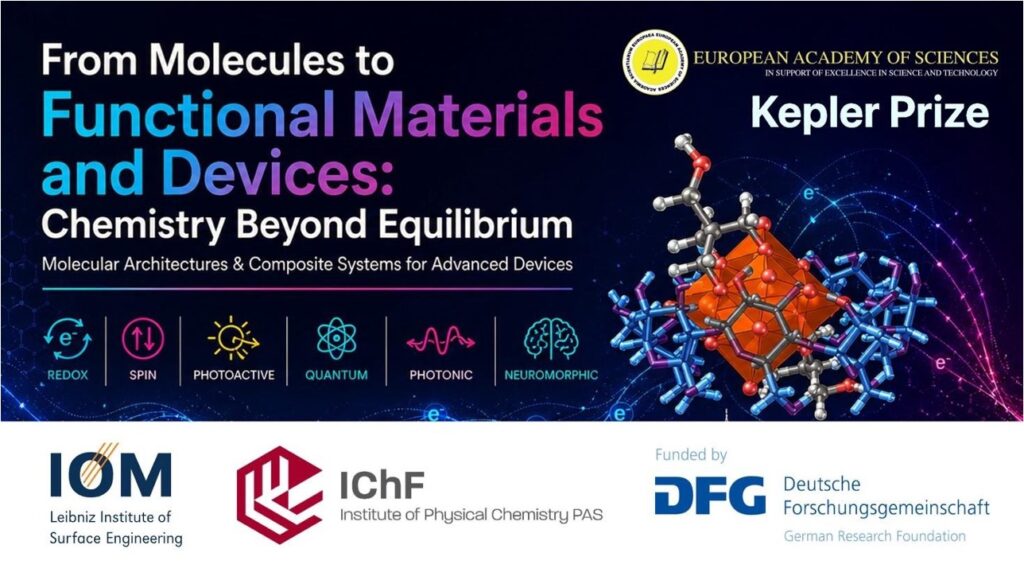
From Molecules to Functional Materials and Devices: Chemistry Beyond Equilibrium
Laureates
Leibniz Institute of Surface Engineering (IOM), Leipzig – Germany
- Yusen Luo
- Jonas Lorenz
- Eric Vogelsberg
Institute of Physical Chemistry (IPC), Polish Academy of Sciences (PAS), Warsaw – Poland
- Daria Larowska-Zarych
- Rafał Zbonikowski
- Tadeusz Rymarz
Scientific Advisor & Liaison
Kirill Monakhov
Leibniz Institute of Surface Engineering (IOM), Leipzig, Germany
Overview
The 2026 edition of the Kepler Prize focuses on one of the most promising frontiers of contemporary science: the interface between molecular systems, advanced materials, and next-generation information technologies.
The awarded interdisciplinary German–Polish team brings together expertise spanning nanoplasmonics, molecular switching systems, theoretical thermodynamics, advanced inorganic materials, and surface engineering, reflecting the Kepler Prize’s mission of fostering cross-disciplinary European scientific collaboration.
The workshop seeks to advance a European research agenda centered on the non-equilibrium chemistry of solution-processable molecular and hybrid architectures, bridging “life-inspired, responsive, and adaptive systems” with future technologies in electronics, computing, photonics, and biomedical engineering.
Workshop Objectives
The workshop aims to:
- promote interdisciplinary collaboration between chemistry, physics, materials science, engineering, and advanced information technologies;
- explore molecular and hybrid architectures beyond equilibrium conditions;
- investigate new functionalities emerging from active molecular systems and composite materials;
- foster future European research initiatives connecting molecular sciences with unconventional computing and biomedical technologies.
Scientific Focus
The scientific programme explores the synthesis, processing, integration, and mechanisms of action of:
- Active Molecular Units
Redox-, spin-, and photoactive molecules designed as multilevel switches, qub(d)its, and multifunctional components. - Composite Systems
Materials across diverse states of matter, emphasizing the transition from molecular properties to bulk functionality. - Next-Generation Devices
Quantum, photonic, and neuromorphic architectures ranging from advanced computing systems to high-precision biological sensing technologies.
Program Highlights
The workshop features:
- 6 Keynote Lectures delivered by internationally recognised experts from five European countries;
- a gender-balanced keynote programme comprising three female and three male keynote speakers;
- 9 Invited Lectures focused on molecular and hybrid systems;
- 9 Early Career Researcher (ECR) Spotlight Talks, highlighting emerging European talent and innovative interdisciplinary research;
- poster sessions and networking activities dedicated to strengthening scientific cooperation across Europe.
Keynote Speakers
Among the keynote speakers featured in the programme are:
- Prof. Ira A. Weinstock — Ben Gurion University of the Negev, Israel
- Prof. E. Carolina Sañudo — Universitat de Barcelona, Spain
- Prof. Petra Hellwig — Université de Strasbourg, France
- Prof. Patrick R. Unwin — University of Warwick, United Kingdom
- Prof. Larysa Baraban — Helmholtz-Zentrum Dresden-Rossendorf (HZDR), Germany
- Prof. Vihar Georgiev — University of Glasgow, United Kingdom
Organisation
Hosted in Leipzig (Germany), the workshop is jointly organised by:
- Leibniz Institute of Surface Engineering (IOM), Leipzig
- Institute of Physical Chemistry (IPC), Polish Academy of Sciences (PAS), Warsaw
The event is organised under the auspices of the Kepler Prize of the European Academy of Sciences (EurASc) and supported by the German Research Foundation (DFG).
Scientific Vision
Many of the most challenging scientific questions emerge “at the boundaries between traditional disciplines.”
The 2026 Kepler Prize workshop embraces this philosophy by bringing together researchers from chemistry, life sciences, materials science, physics, mathematics, engineering, and computational sciences to explore new scientific territories and future European collaborative initiatives.