
In Memoriam – Professor Karl Otto Christe
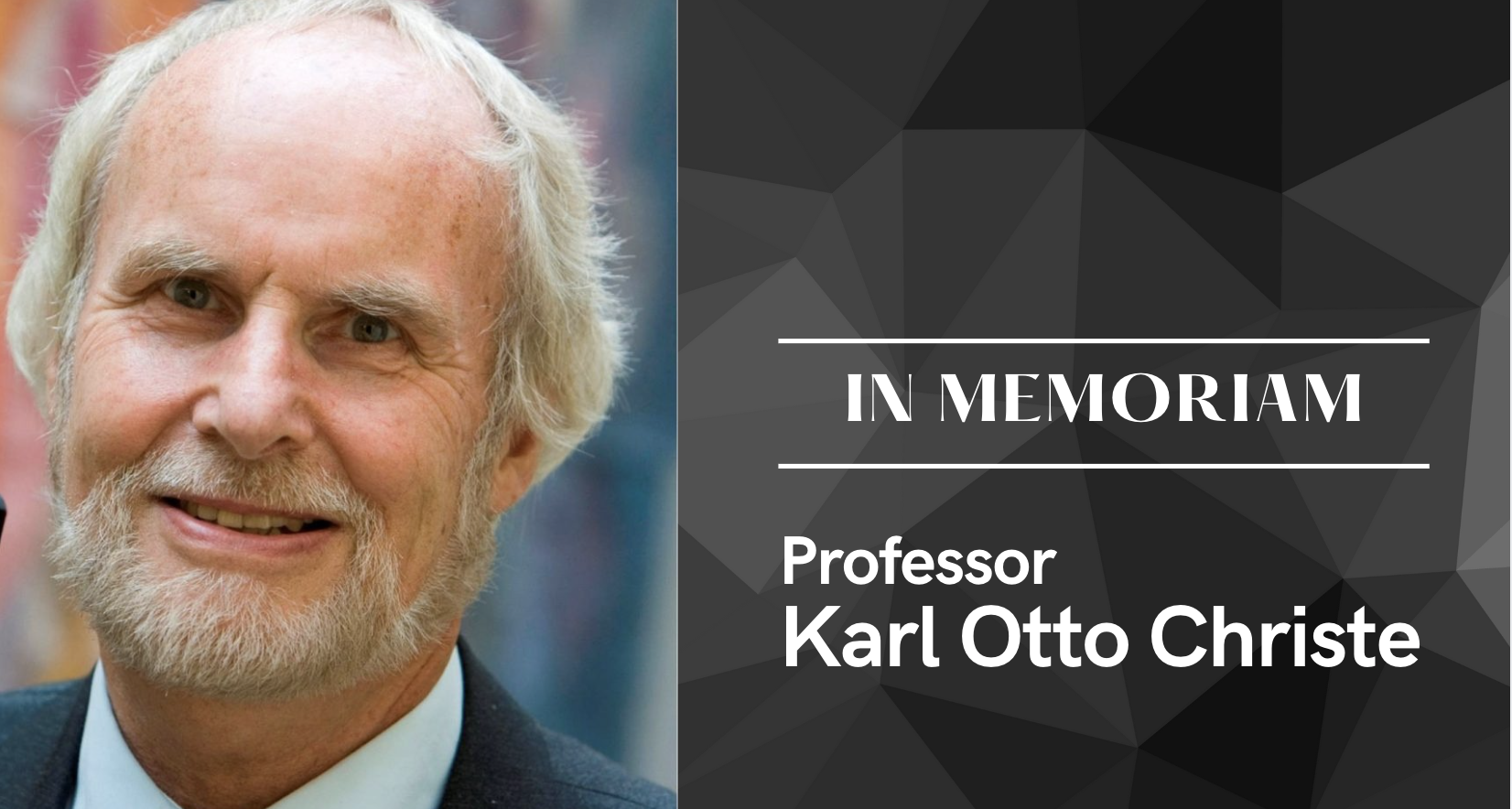
The European Academy of Sciences (EurASc) announces with deep sorrow the passing of Prof. Karl Otto Christe, Emeritus Fellow of the EurASc and Emeritus Professor in the Department of Chemistry, University of Southern California (USC), who passed away on 19 April 2026, at the age of 89.
Born on 24 July 1936 in Ulm, Germany, as a third child with two elder sisters, Karl Christe credited his father, a high school chemistry teacher, for blessing him with a logical mind and self-discipline, and his mother, who came from a book, art and music shop, with a fair share of creativity and the ability to improvise. The family moved in 1939 to Bad Mergentheim, a small resort town in northeastern Baden-Württemberg where Karl attended elementary and high school. His father was drafted in 1942 because of his open opposition to the Third Reich and was killed in action in 1944 on the Western Front.
Karl Christe began his chemistry studies in 1957 at the University of Stuttgart where he obtained his diploma- (1960) and Ph.D. (1961) research under the supervision of Prof. Josef Goubeau. He immigrated to the U.S. in 1962 and settled in California, where he commenced working as a senior research chemist at Stauffer Chemical Co. in Richmond, California. He joined Rocketdyne Division, Rockwell International, Canoga Park, Los Angeles in 1967 where he rose to Manager of Exploratory Chemistry in 1978. In 1994, he accepted joint positions with the U.S. Air Force Research Laboratory, Edwards Air Force Base (Mojave Desert) and the Loker Hydrocarbon Research Institute, USC. In 2005, he moved full-time to USC where he continued to work as a research professor.
Prof. Christe is internationally recognised for his pioneering contributions across a broad front of synthetic/structural inorganic fluorine chemistry and high-energy density materials (HEDM) research. Since the 1960s, Christe had investigated the synthesis of new fluorides of nitrogen, halogen fluorides, oxyfluorides, and the halogen oxides, as well as their cations and anions. Some notable examples are the syntheses and structural characterizations of the powerful oxidants, NF4+, NOF2+, ClF6+, ClO2F3, and ClF6−. In 1986, the centenary of Henri Moissan’s first production of elemental fluorine by an electrolytic procedure, Christe reported the first true chemical synthesis of F2. He subsequently developed a method to make the truly anhydrous “naked’ fluoride source, (CH3)4N+ F−,which enabled the syntheses of numerous high-coordination-number main-group hypervalent fluoride and oxyfluoride anions such as PF4−, POF2−, POF4−, TeOF62− TeF7−, IOF6−, IO2F52−, and XeF5−. Another outstanding aspect of his research are his contributions to polynitrogen chemistry and his synthesis of the bent pentazenium cation, N5+. This work was extended to homoleptic high-nitrogen-content main-group and transition metal polyazido species such as Nb(N3)72− and to the N5+ salts, N5+B(N3)4− and N5+P(N3)6− for applications as energetic materials. He was the first to experimentally detect the cyclic pentazolate anion, N5− and to prepare stable high-nitrogen-content pentazolates.
Prof. Christe was a member of the American Chemical Society and the German Chemical Society and received numerous awards: ACS M. Frederick Hawthorne Award in Main Group Inorganic Chemistry (2021); ACS Award for Creative Research and Applications of Iodine Chemistry (2015); ACS Richard C. Tolman Award (2011); Alfred Stock Memorial Prize, Gesellschaft Deutscher Chemiker (2006); ACS Award in Inorganic Chemistry (2003); Prix Henri Moissan, Fondation de la Maison de la Chimie, Paris (2000); U.S. Air Force Star Team Award (1999); ACS Award for Creative Work in Fluorine Chemistry (1986); and NASA’s Apollo Achievement Award (1969). He was elected to the European Academy of Sciences (Brussels) in 2009, the European Academy of Sciences and Arts (Salzburg) in 2010, and the American Association for the Advancement of Science in 2017. Prof. Christe authored approximately 550 scientific publications and held approximately 65 patents.
The EurASc community extends its sincere condolences to Karl Christe’s family, and to his many friends and colleagues worldwide.