
KEPLER PRIZE 2011
Managing Complexity, Reducing Perplexity – Complex Living Systems
Overview
The 2011 edition of the Kepler Prize focused on the study and management of complexity in living systems through interdisciplinary scientific approaches combining mathematics, physics, biology, and computational sciences.
The workshop explored emerging mathematical paradigms and predictive models aimed at improving the understanding, forecasting, and control of complex biological phenomena. Particular emphasis was placed on collective behaviours, multiscale dynamics, tissue morphogenesis, cancer modelling, and the emergence of biological structures.
Workshop Objectives
The workshop aimed to:
- promote interdisciplinary collaboration between researchers in life sciences, mathematics, physics, and computer sciences;
- encourage exchanges between scientific communities working on complex living systems;
- identify promising research directions and future collaborative opportunities;
- foster discussions on modelling, robustness, adaptation, and emergent biological behaviour.
Main Topics
- Regulatory Networks
- Cell Motility
- Morphogenesis
- Multiscale Cancer Modelling
- Formation of Biological Structures
- Evolution and Adaptation
Organisation
Hosted in Heidelberg (Germany), the workshop was organised in collaboration with EMBL Heidelberg and the Politecnico di Torino.
Organisers
- A. Picco (EMBL Heidelberg)
- G. Ajmone Marsan (OECD, Paris)
- M. Delitala (Politecnico di Torino)
Scientific Vision
Interdisciplinarity was at the core of the workshop’s philosophy, bringing together researchers from multiple scientific domains to examine how complex biological systems can be described, analysed, and ultimately better understood through quantitative and computational approaches.
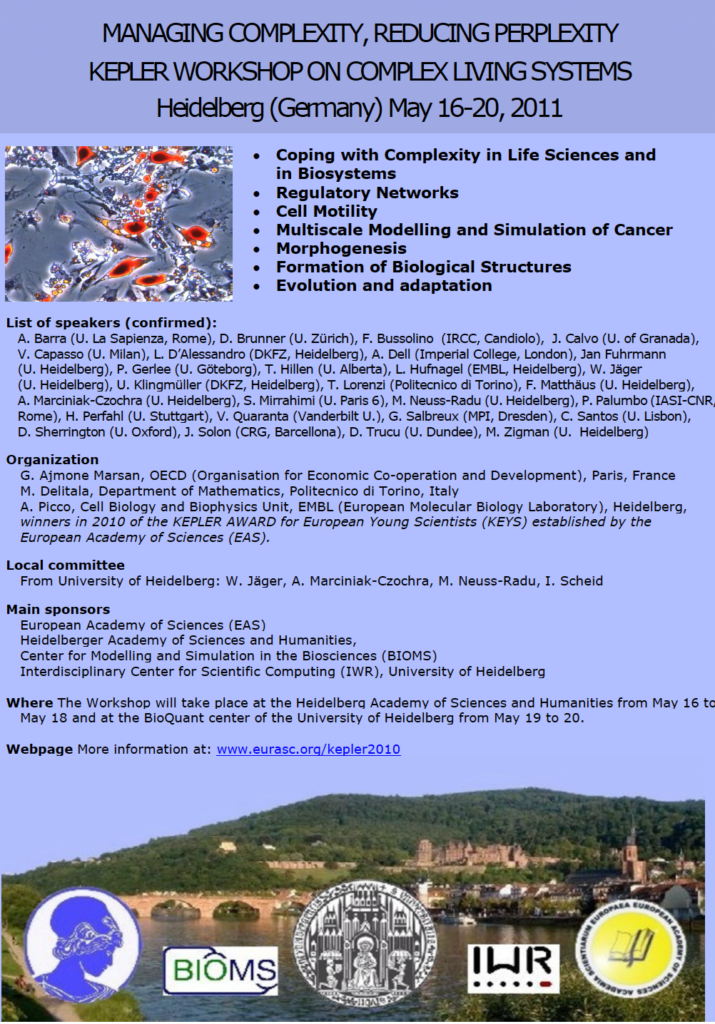
Main Topics
- Regulatory Networks
- Cell Motility
- Morphogenesis
- Multiscale Cancer Modelling
- Formation of Biological Structures
- Evolution and Adaptation
Organisation
Hosted in Heidelberg (Germany), the workshop was organised in collaboration with EMBL Heidelberg and the Politecnico di Torino.